Your Home Office Deserves Better Coffee — Here's How to Build a Setup That Pays for Itself
Something shifted when millions of Americans stopped commuting and started working from their kitchen tables. The 8 a.m. drive-through run disappeared. The office Keurig became someone else's problem. And suddenly, people were confronted with a question they'd never really had to answer before: What do I actually want my coffee to taste like?
For a lot of remote workers, the answer involved spending more money on beans than they ever had before — and it turns out that might be one of the smarter financial decisions they've made.
The Remote Work Coffee Shift Nobody Saw Coming
Before the mass work-from-home transition, the average American office worker's coffee routine was largely passive. You drank what was there: the break room drip machine, the coffee cart downstairs, the Starbucks on the commute. Personal preference was secondary to convenience.
Working from home changed the equation completely. Now you're the one buying the beans, running the machine, and — critically — living with the results all day. That shift in ownership tends to create a shift in standards.
Data from the Specialty Coffee Association and retail tracking firms showed a notable spike in home coffee equipment sales and premium bean purchases starting in 2020 and continuing well beyond it. Americans weren't just making coffee at home more often — they were making better coffee at home, on purpose, with intention.
And the spending math, once you actually run it, is pretty hard to argue with.
The Latte Math Problem
Let's do some honest accounting here. A specialty coffee drink at a café — your oat milk latte, your cold brew, your whatever — runs somewhere between $5 and $8 in most American cities. If you were grabbing one on the way to the office five days a week, that's $25 to $40 a week, or somewhere between $1,300 and $2,000 a year.
A bag of genuinely excellent single-origin coffee from Island Joe's runs around $25 to $45 and makes roughly 30 cups depending on your brew ratio. Even at the high end, that's about $1.50 per cup.
A solid pour-over setup — a quality dripper, a gooseneck kettle, a burr grinder — runs maybe $150 to $300 as a one-time purchase. That setup pays for itself in coffee shop savings within a few months. After that, you're banking the difference every single week.
This is why remote workers spending more on premium beans isn't financially reckless — it's actually the opposite. You're trading a daily $6 habit for a $1.50 habit that tastes better because you made it exactly the way you like it.
What a Great Home Coffee Station Actually Needs
You don't need a commercial espresso machine or a setup that looks like a café counter. You need a few well-chosen tools and decent beans. Here's what actually matters:
A Burr Grinder (Non-Negotiable)
If you're buying whole-bean coffee and grinding it with a blade grinder, you're leaving quality on the table. Blade grinders chop unevenly, which means some grounds are too fine and some are too coarse — and that inconsistency creates a muddled, often bitter brew.
A burr grinder crushes beans between two abrasive surfaces for a uniform grind size. You don't need to spend $300 on one. A solid manual burr grinder runs $30 to $60 and does the job beautifully. An electric version with consistent results starts around $80 to $100.
This is the single upgrade that will improve your coffee more than anything else, including the beans themselves.
Your Brew Method
Choose one and learn it well. Here are the three most home-office-friendly options:
Pour-Over: Produces a clean, nuanced cup that shows off the terroir of a good single-origin bean. Takes about four minutes of active attention. Great for the mid-morning reset when you want to step away from the screen for a few minutes anyway. A Hario V60 or Chemex setup costs $30 to $50.
French Press: Lower investment, more forgiving technique, produces a full-bodied cup with more texture. Great for those mornings when you need coffee fast and don't want to fuss. A quality French press runs $25 to $45.
Aeropress: Compact, fast, versatile, nearly unbreakable. Makes a concentrated cup that can be adjusted for everything from espresso-style to a lighter Americano. Beloved by travelers and home brewers alike. Around $35.
Pick one. Get good at it. Then maybe explore the others.
A Gooseneck Kettle
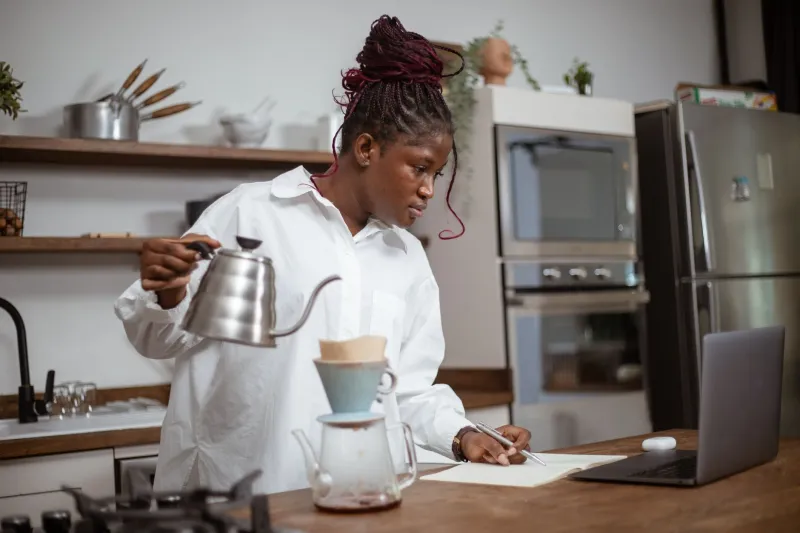
If you're doing pour-over, you need control over where the water lands. A gooseneck kettle — one with a long, thin spout — lets you pour in slow, steady spirals over the grounds rather than dumping water on them all at once. That control affects extraction quality significantly.
An electric gooseneck kettle with temperature control (important — you want water around 200°F, not boiling) runs $40 to $80. Worth every penny if pour-over is your method.
The Beans
This is where Island Joe's comes in. For a home office setup, we'd suggest keeping two bags on hand: a medium roast single-origin for your focused work mornings when you want to taste something interesting, and a reliable blend for the days when you just need the thing to be good and consistent without any thinking involved.
Store your beans in an airtight container away from direct light. Buy whole bean and grind fresh. And don't buy more than you'll use in two to three weeks — coffee goes stale, and stale coffee is a waste of good money.
The Ritual Is Part of the ROI
Here's something the pure math doesn't capture: the act of making good coffee at home is a genuine mental reset in the middle of a workday that can otherwise blur into an unbroken stream of video calls and Slack notifications.
Taking five minutes to grind beans, heat water, and pour a careful cup is a small, tactile break from screen time. It's the kind of micro-ritual that remote workers who thrive tend to build into their days deliberately. It marks time. It creates a transition.
The island philosophy — slow down, be present, pay attention to what's in front of you — applies here as much as it does on a beach in Kauai. Your home office might not have an ocean view, but it can absolutely have great coffee.
And at $1.50 a cup, you're saving enough to actually book the flight.