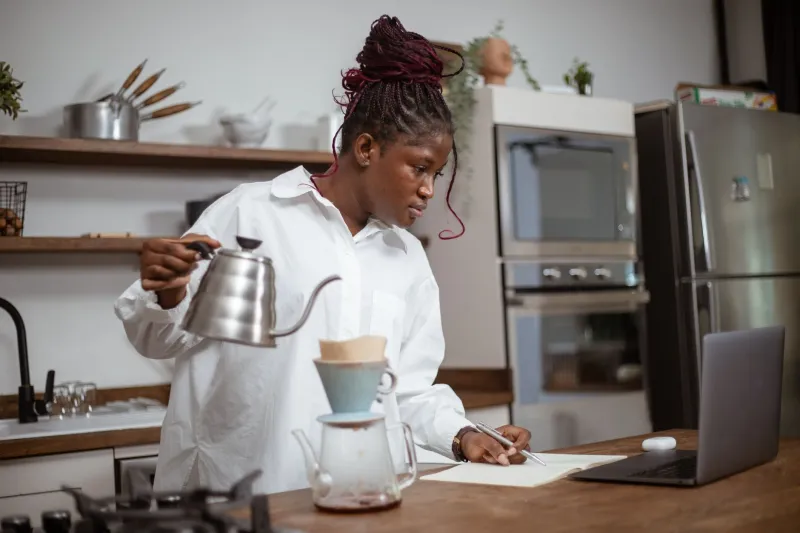
Before You Order That Refill: What Caffeine Science Says About Your Second Cup
It happens to most of us. You finish your first coffee, feel pretty good for about forty-five minutes, and then — almost on autopilot — you're either back at the espresso machine or opening a café app to reorder. It feels like a rational response to flagging energy. But is it?
The short answer: usually not. The longer answer involves caffeine half-lives, adenosine receptors, coffee shop revenue models, and a surprisingly simple fix that most people never try. Let's get into it.
Why Coffee Shops Love Your Second Cup
Before we get into the biology, let's acknowledge the obvious: the entire coffee shop experience is engineered around the refill. Free refill policies, loyalty apps that reward frequency, comfortable seating designed to make you linger — all of it nudges you toward consuming more.
This isn't a conspiracy. It's just business. A customer who orders twice is worth more than a customer who orders once and leaves. Loyalty programs in particular are built to make frequent ordering feel like a reward rather than a spending habit. You're not earning free coffee — you're being gently conditioned to buy more of it.
None of this is sinister, but it's worth being aware of. The impulse to order a second cup is partly physiological and partly manufactured. Knowing the difference gives you more control over both your caffeine intake and your wallet.
The Adenosine Problem
Here's the core of what's happening when caffeine "wears off." Caffeine works by blocking adenosine receptors in your brain. Adenosine is a neurotransmitter that builds up throughout the day and makes you feel progressively sleepier. Caffeine doesn't give you energy — it temporarily blocks your ability to feel the tiredness that's already accumulating.
When the caffeine clears, all that blocked adenosine floods back in at once. This is the crash. It's not that you've run out of caffeine energy — it's that your brain is suddenly processing a backlog of fatigue signals it was prevented from receiving earlier.
Here's the catch: your second cup doesn't reset this process. It delays it. And because adenosine continues building while caffeine is blocking it, the crash after cup two can actually hit harder than the one you were trying to avoid in the first place.
Caffeine's Half-Life Is Longer Than You Think
Caffeine has a half-life of roughly five to six hours in most adults, though genetics, medications, and liver function can shift this significantly. What that means practically: if you drink a 200mg cup of coffee at 8 a.m., you still have about 100mg of caffeine in your system at 1 or 2 p.m.
When people reach for a second cup at 10 or 11 a.m., they're often still carrying a meaningful amount of caffeine from their first. The perceived energy dip isn't a deficit — it's a natural fluctuation in how caffeine interacts with your adenosine receptors over time. Adding more caffeine on top of an already active dose doesn't double the effect. It increases the total load your nervous system has to metabolize, which often results in jitteriness, anxiety, or a harder crash later.
Consuming your second cup after 2 p.m. pushes significant caffeine into the late evening, which research consistently links to reduced sleep quality — even when people report falling asleep without difficulty. Poor sleep increases fatigue the next morning, which drives the desire for more coffee. It's a cycle that a thoughtful brewing strategy can interrupt.
The Case for Drinking Less, Better
This is where roast quality and brew method actually matter for your daily functioning — not just your taste experience.
A coffee with more nuanced, developed flavor rewards slower drinking. When you're genuinely savoring a cup — noticing the finish, the body, the subtle fruit notes — you drink less of it in the same amount of time. You also feel more satisfied by it, which reduces the psychological pull toward a refill.
At Island Joe's, our roast profiles are developed with this in mind. A well-roasted island single-origin isn't just about flavor complexity for its own sake — it's about creating a cup that's worth lingering over. A coffee you actually enjoy tends to be a coffee you drink more slowly, and slower drinking naturally spaces your caffeine intake in a way that your nervous system handles better.
Optimal Timing: What the Research Actually Suggests
If you want to get the most out of your coffee without the crash, timing matters more than quantity. Here's a practical framework based on how caffeine interacts with your body's natural cortisol rhythms:
Wait before your first cup. Cortisol peaks shortly after waking — typically between 8 and 9 a.m. for most people. Drinking coffee during this window doesn't give you much of a boost because your body is already producing its own alertness hormone. Waiting until cortisol starts to dip, usually around 9:30 to 10 a.m., means your first cup lands when your body actually needs the assist.
Space cups by at least 90 minutes. If you do want a second cup, give your system time to process the first one. A 90-minute gap allows the initial caffeine curve to stabilize and reduces the likelihood of stacking doses in a way that leads to a bigger crash.
Set a hard cutoff. For most people, 1 p.m. is the practical limit for a second cup if you want to protect sleep quality. If you're particularly sensitive to caffeine, noon is a safer boundary.
Consider brew strength over volume. A smaller, properly extracted cup of high-quality coffee delivers a cleaner caffeine curve than a large, over-extracted one. More isn't better — better is better.
What "Better" Coffee Actually Buys You
The argument for investing in quality roasts isn't just about taste snobbery. It's about efficiency. A coffee with a clean flavor profile and thoughtful extraction gives you a more predictable, even caffeine experience. There are fewer bitter compounds that stress your digestive system, more aromatic compounds that engage your senses fully, and a natural incentive to drink slowly.
Island Joe's roasts are designed to be satisfying on their own terms — not as a delivery system for maximum caffeine, but as a genuine experience worth your full attention. When your first cup is that good, the case for a second one gets a lot weaker.
Try it tomorrow morning. Brew one exceptional cup. Drink it slowly, without your phone. Wait until 10 a.m. to start it. See how far that single cup actually carries you.
You might be surprised how little you needed that refill after all.